
Updated October 22, 2026, with the certification label rules in 49 CFR 567.4, current CBP, NHTSA and EPA import guidance, and the 2026 duty rates.
Two stickers decide whether a car under 25 years old can come into the US: the safety certification label on the driver's door jamb and the emissions label under the hood. A US-spec car with both enters as an ordinary conforming vehicle, while the same model built for Europe or Japan may have no permanent way in at all. Our view is simple: check the labels before you check the service history.
Disclaimer: This article is for informational purposes only and reflects US import rules as of October 2026. Verify your car's status with CBP, NHTSA and EPA, and confirm duty with your licensed customs broker before you buy.
By the numbers: what US-spec means at the border
- 2 labels: the manufacturer's FMVSS certification label (DOT) and the Vehicle Emission Control Information label (EPA).
- 0 approvals: NHTSA approval is not needed before importing a car that carries its original certification label (NHTSA).
- 1.5 times the dutiable value: the DOT bond on a car without the label that has to be brought into compliance (CBP).
- 25 years: the age at which the safety standards stop applying to a permanent import (CBP).
- 15%: duty on an EU- or Japan-built car under 25, base rate included, before MPF and HMF.
Label 1: the safety certification label on the door jamb
CBP says it plainly: "A vehicle must be imported as a nonconforming vehicle unless it bears the manufacturer's label certifying that it meets U.S. standards." That label is what makes a US-spec car US-spec in the eyes of customs.
Federal rules (49 CFR 567.4) put it on the hinge pillar, the door-latch post, or the door edge that meets the latch post, next to the driver's seat. Read it line by line:
- "Manufactured by" or "Mfd by" with the manufacturer's name.
- Month and year of manufacture, the date main assembly was finished.
- Gross vehicle weight rating (GVWR) in pounds, and the axle ratings.
- The VIN, which must match the title and the chassis.
- The statement: "This vehicle conforms to all applicable Federal motor vehicle safety, bumper, and theft prevention standards in effect on the date of manufacture shown above."
No statement, no US-spec car, however American the car looks. A model that was also sold in the US but built for another market usually carries a different label, or none. We would not pay a US-spec premium on a seller's word or a photo of the dashboard; ask for a clear photo of this label before you bid.
Label 2: the emissions label under the hood
EPA's label is titled "Vehicle Emission Control Information." It names the manufacturer and carries "an unconditional statement of compliance with EPA emission regulations." On cars it sits under the hood or in the engine compartment. On motorcycles, look under the seat, on the frame or in the glove compartment.
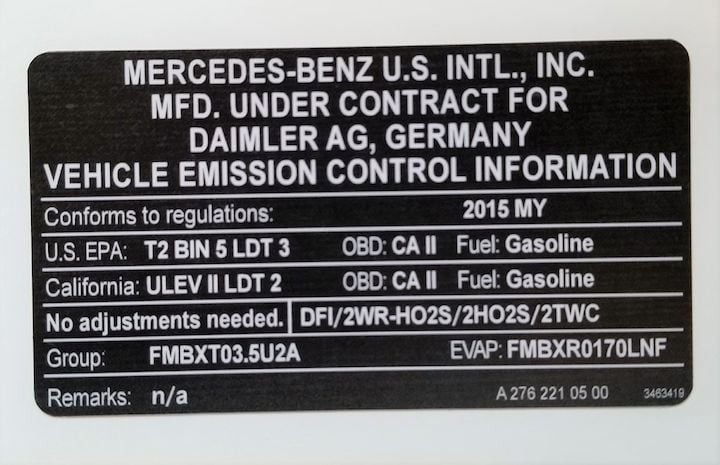
CBP expects this label "on the engine compartment in English." Without it, "the CBP inspector at the port of entry may require proof of eligibility to import under the EPA exemptions or exclusions specified on form 3520-1." A car under 21 years old that fails this check has to go through an Independent Commercial Importer (ICI) for modification and testing, arranged before the car ships.
What if a label is missing?
Labels get painted over, lost in a door swap or peeled off in a restoration. NHTSA's advice: "If you are unable to find a certification label on a particular vehicle... you should contact the vehicle's manufacturer." What you want back is a letter from the manufacturer that confirms the specific VIN was built to US standards, plus photos of the VIN plate. Ask for it before the car is loaded, not while it waits at the port.
CBP also lets you speed things up on a US-certified car bought abroad: "make sure the sales contract identifies this fact" and present the contract at entry. One line in the bill of sale costs nothing.
US-spec vs. gray market: why we prefer the US car
A gray-market car is one built for another market and never certified for the US. Under 25 years old, NHTSA says it "cannot be lawfully imported into the U.S. on a permanent basis unless NHTSA determines it eligible." Eligibility is decided on a make, model and model year basis, and eligible cars "may ONLY be imported under bond and by an RI," a Registered Importer.
That route is real, but every step adds cost and months. A US-spec car of the same model skips all of it. Where a buyer abroad has a choice between a European-spec car and a US-spec car exported years ago, we would take the US-spec car, even at a higher price, unless the car is already 25. At 25 the label stops mattering for safety, and the 25-year rule takes over. For emissions, EPA's age test is 21 years, with the original engine.
Forms and duty for a US-spec car coming in
Every car needs EPA Form 3520-1 and DOT Form HS-7, "declaring the emissions and safety provisions under which the vehicle is being imported" (CBP). NHTSA says a car with its original certification label "can be imported as a conforming motor vehicle under Box 2A on the HS-7."
US-spec does not mean duty free. Duty follows the country where the car was built:
- EU- or Japan-built car under 25: 15% all-in under Section 232. On $40,000 that is $6,000, plus $138.56 MPF and $50 HMF: $6,188.56.
- EU-built car 25 or older: 10% combined (HTS 9903.05.39). On $40,000: $4,188.56 with fees.
- UK- or Japan-built car 25 or older: 12.5% total.
- A US-built car coming home can enter free as American goods returned (HTS 9801.00.10), with the proof of US origin on the importer. Our Dubai import guide covers how that works.
The fees are the Merchandise Processing Fee at 0.3464% (minimum $34.58, maximum $670.86 from October 1, 2026) and the Harbor Maintenance Fee at 0.125% on ocean entries. Detail in HMF, MPF and customs bonds explained. A licensed customs broker files the entry.
FAQ: US-spec cars and import labels
How do I tell if a car is US-spec?
Look for the manufacturer's certification label on the driver's door jamb stating the car conforms to all applicable Federal motor vehicle safety standards, and the Vehicle Emission Control Information label under the hood stating compliance with EPA regulations.
Where is the federal certification label?
On the hinge pillar, the door-latch post, or the door edge that meets the latch post, next to the driver's seat (49 CFR 567.4).
What if the certification label is missing?
NHTSA advises contacting the vehicle's manufacturer. Ask for a letter confirming the VIN was built to US standards, and keep photos of the VIN plate.
Can I import a car under 25 years old that is not US-spec?
Only if NHTSA has found the model eligible, and then only through a Registered Importer under a bond of 1.5 times the dutiable value. Emissions conversion goes through an ICI.
Does a US-spec car pay import duty?
Yes, by country of manufacture: 15% for an EU- or Japan-built car under 25, 10% or 12.5% for classics 25 and older, plus MPF and HMF. A US-built car returning can enter free with proof of US origin.
More US Import Guides
- The 25-year rule in 2026
- Show or Display: how it works
- EPA tourist procedure for temporary imports
- What duties classic car imports pay today
- Import a car from Dubai to the USA
- What a Japan import costs in 2026
Found a US-spec car at an auction or dealer overseas? We ship it door to door by ocean or air, and our own team loads every car and handles every document on the shipping side. Our own warehouses in California, Florida and New Jersey cover all of the US for imports and exports. Price it in the car import calculator.
It's your dream car. Let's bring her home.

Shipping Electric Vehicles: 2026 Rules + Banned Cars
How to Sell a Classic Car: 5 Sites and Their Fees | 2026