
In 1990, Mercedes handed one of its own sedans to Porsche and asked them to finish it. The result was the 500E: a W124 with a 5.0L V8, wider fenders, and an 18-day assembly process split between two factories. Only 10,479 were ever built, and in October 2026 the CLASSIC.com benchmark sits at $52,606 for a 500E and $73,555 for the later E500, with the top recorded sale at $357,000 in March 2026.
We ship a lot of 1990s Mercedes between the US, Germany, the UK and the Gulf. Most of them are good cars. The 500E is the one we would buy ourselves, and this article is our case for why it was special in 1992, why it still is, and what it costs to own one on either side of the Atlantic.
Why Porsche Built a Mercedes
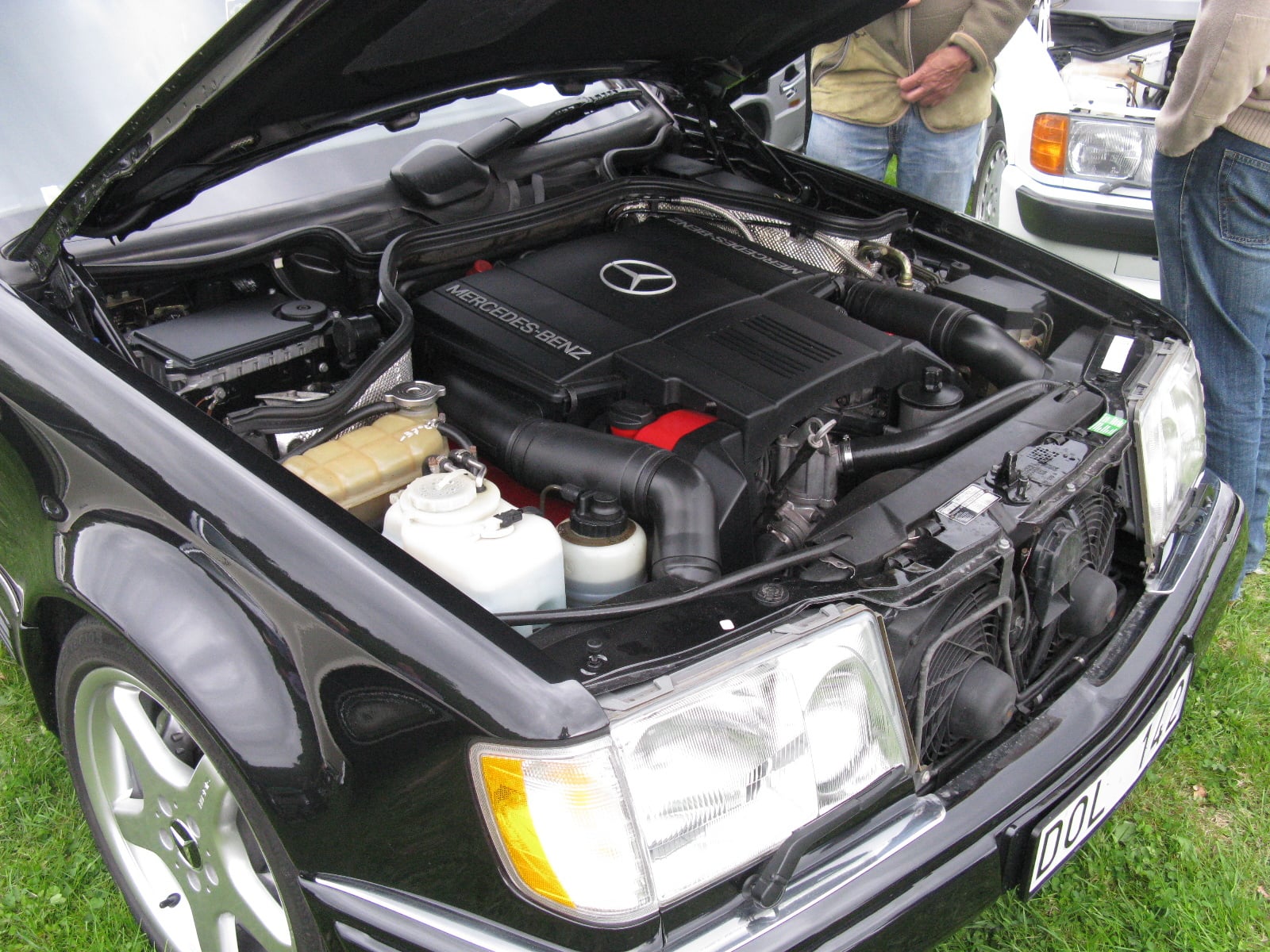
Mercedes wanted a V8 version of the W124 but had no spare capacity. Every line in Sindelfingen was committed to the new W140 S-Class. Porsche, meanwhile, was short on work and had floor space in Zuffenhausen, including the Rössle-Bau hall where the car would be finished.
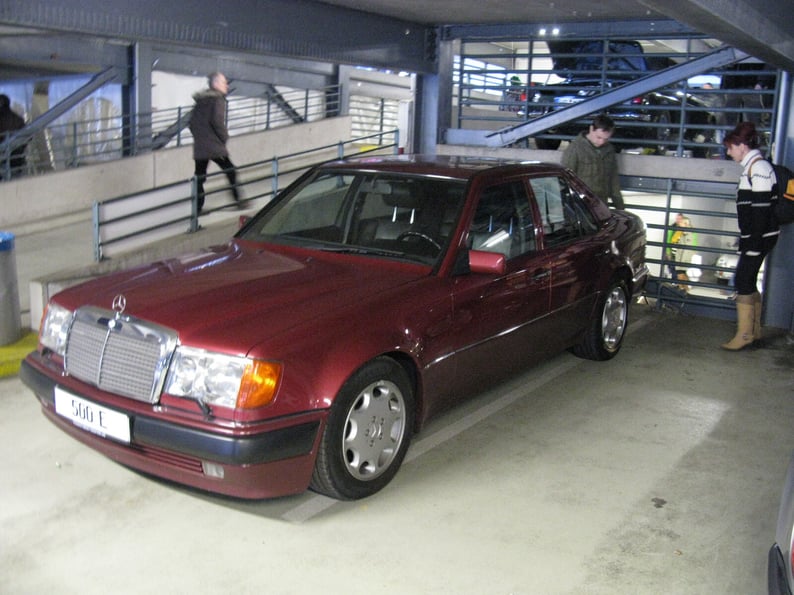
So the two companies agreed on a plan that would never survive a modern cost review. Porsche engineered the car: the M119 5.0L V8 from the 500 SL, a reworked front subframe, a body 56mm wider to clear the new track, and a ride height 23mm lower. Each shell was built in Sindelfingen, trucked to Zuffenhausen for Porsche to assemble the chassis and drivetrain, trucked back to Sindelfingen for paint, then returned to Porsche for final assembly. Eighteen days per car, ten cars a day at the start and twenty once the orders came in.
It made 322hp, reached 100km/h in 6.1 seconds, and was limited to 155mph. In 1992 that put a four-door Mercedes in the same conversation as a Porsche 928. The car looked like a well-specced E-Class with a slightly wider stance. That was the point.
What the 500E Is Compared To
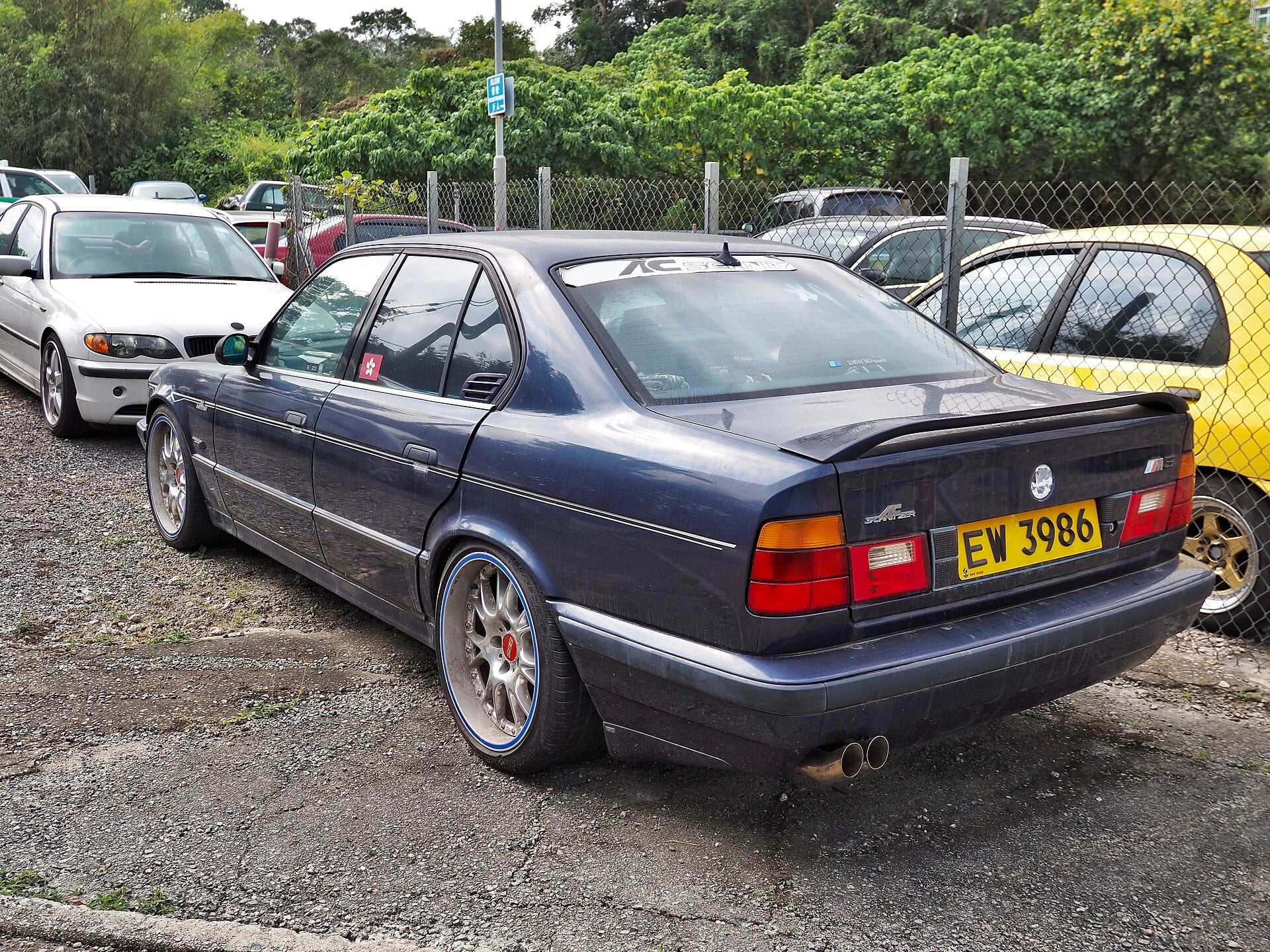
The 500E's natural rival was the BMW E34 M5, also hand-assembled in small numbers, also a sedan that gave nothing away at a traffic light. The M5 was the sharper car, with a 3.8L inline six and a manual gearbox. The 500E was the one you could drive from Munich to Monte Carlo on a Friday night and still feel like stepping out for dinner. Both are collector cars now, but the 500E has the Porsche story and the M5 does not.
The other comparison that comes up is the Audi RS2 Avant, which Porsche built in the same Zuffenhausen hall two years later. Same recipe: a sensible body, a Porsche-assembled drivetrain, a short production run of 2,891 cars. RS2 values have climbed past the 500E in Europe, and we think that gap is temporary. The 500E has a V8, four seats in a proper sedan, and roughly three times the production numbers, which means a real market instead of a handful of trades a year.
Inside Mercedes, the closest thing is the W124 E60 AMG, the factory-built 6.0L version that followed. It is faster and far rarer, but it is an AMG. The 500E is the only Mercedes that was ever built by Porsche, and that sentence does not expire.
Why It Will Always Be a Collector Car
Collector cars hold value for a short list of reasons, and the 500E checks all of them. Fixed, low production: 10,479 cars from 1990 to 1995, of which roughly 1,500 came to the US. A story that cannot be repeated: two rival manufacturers sharing a car across two factories. An era that ended: the W124 was the last Mercedes engineered before the cost-cutting of the late 1990s, and the 500E is its most expensive expression.
It also has the quality that keeps a car in demand after the first wave of nostalgia buyers ages out. You can drive it. The M119 V8 is well documented, the W124 parts supply is deep, and a sorted 500E runs daily without complaint. A Lotus Carlton is rarer and faster, and most of them sit in climate-controlled garages because nobody wants to fix one. The 500E gets used.
The market reflects this. Recorded 500E sales span $13,000 to $357,000, which sounds like chaos until you look closer. The $13,000 cars are 200,000-mile examples with deferred maintenance. The six-figure cars are low-mileage, documented, often one-owner. The middle, where most of the cars live, has moved steadily upward for a decade without a correction worth naming. That is what a permanent collector car looks like on a chart.
500E vs E500: Which One to Buy
The car was badged 500E for 1992 and 1993 and E500 for 1994 and 1995, when Mercedes reordered its naming. The later cars got the facelift grille, updated interior trim and, in Europe, the short-run E500 Limited with its own colors, trim and wheels. The E500 benchmark is $73,555 against $52,606 for the 500E, so the market pays about $20,000 for the facelift and the rarity.
Our take: the 1992 500E is the purer car and the better value. It is the one that carries the original name and the original story. If you want the last and most refined version, buy a 1995 E500. Either way, buy service history first and the car second. A 500E with a documented wiring harness replacement and a recent head gasket job is worth paying for.
The Rest of the 90s Mercedes Lineup
For context, here is where the 500E sits against the other 1990s Mercedes collectors ask us about.
| Car | Model years | CLASSIC.com benchmark | Average sale |
|---|---|---|---|
| Mercedes 500E (W124) | 1992 to 1993 | $52,606 | $47,205 |
| Mercedes E500 (W124) | 1994 to 1995 | $73,555 | $66,052 |
| Mercedes 600SEL (W140) | 1992 to 1993 | $20,369 | $26,230 |
| Mercedes S600 / S600 L (W140) | 1994 to 1999 | $43,254 | $36,683 |
| Mercedes E320 Wagon (S124) | 1993 to 1996 | $14,428 | $14,858 |
| Mercedes 300GE (W463) | 1990 to 1994 | $37,666 | $36,141 |
| Mercedes 500GE (W463) | 1993 to 1994 | $45,241 | not listed |
Source: CLASSIC.com market data, October 2026. Benchmarks move with every sale, so check the live market before you bid.
The W140 S600 has a 390hp V12 and a $2,750 to $87,000 sales range, which tells you everything about what deferred maintenance does to a flagship. The S124 E320 wagon is the entry point at $14,428 and still the cheapest ticket into W124 ownership. The G-Class is a different story: never sold new in the US until 2002, so every 1990s 300GE and 500GE here arrived as a grey-market car or under the 25-year rule. Only 446 500GEs were built, and most of them are still in Europe.
None of these is a 500E. The S600 was built in volume, the wagon was built in volume, and the G-Class was built for 45 years. The 500E was built for five years by two companies that never worked together again.
Where the 500Es Are
About 8,900 of the 10,479 cars stayed in Europe, which is why American buyers increasingly shop Germany. A Euro-spec 500E has no 25-year problem (every one is past 30 now), comes with Mercedes' own service records, and often has fewer miles than the US cars that were driven as intended. Our guides to buying a car in Germany and the German car auction sites cover the purchase, and the import calculator gives you the landed cost into New Jersey or California.
The traffic runs the other way too. US-spec E500s go to buyers in Germany, the UK and the Gulf, where a clean American car with a known history sells well. Current per-car ocean container rates from our calculator:
- New Jersey to Bremerhaven: $1,100, 30-33 days
- California to Bremerhaven: $1,850, 40-45 days
- New Jersey to Southampton: $1,200, 14-16 days
- New Jersey to Jebel Ali: $1,350, 65-70 days
Air freight is the option when the car has to make an event date. Before a US car is registered in Germany it goes through the TÜV inspection. For any other lane, use the export calculator.
Frequently Asked Questions
Why is the Mercedes 500E so special?
It is the only Mercedes ever built by Porsche. Each car took 18 days and repeated trips between Sindelfingen and Zuffenhausen, only 10,479 were made from 1990 to 1995, and the 322hp M119 V8 gave a plain-looking W124 sedan the performance of a Porsche 928.
How much is a Mercedes 500E worth in 2026?
The CLASSIC.com benchmark is $52,606 for a 1992 to 1993 500E and $73,555 for a 1994 to 1995 E500. Recorded sales run from $13,000 for high-mileage cars to $357,000 for the top sale in March 2026.
What is the difference between the 500E and the E500?
Same car, different badge. Mercedes renamed it E500 for 1994 with the facelift grille and updated trim. In Europe, the 1994 to 1995 E500 Limited added unique colors, trim and wheels on a short final run.
How much does it cost to ship a 500E from Germany to the US?
Run the import calculator for a landed cost into New Jersey or California, including ocean freight, duty and our warehouse handling. Going the other way, our rate from New Jersey to Bremerhaven is $1,100 per car in a shared container, 30-33 days.
More 1990s Car Guides
- Best 90s Cars: 1990s Icons, Values and How to Import
- Best 90s Sports Cars by Price
- The Most Popular German Cars Imported to the USA
- The 25-Year Rule for US Car Imports
Ready to Bring a 500E Home?
We ship 500Es and every other 90s Mercedes door to door, by ocean or air, through our own warehouses in California, Florida and New Jersey. Our own team loads every car and handles every document, whether it is a Euro-spec 500E won at auction in Stuttgart or a US-spec E500 headed to a garage in Dubai. Start with our international car shipping page or get a rate from the calculator below.
It's your dream car. Let's bring her home.


The Most Popular German Cars Imported to the USA in 2026
2001 German Cars Now 25-Year Eligible: E46 M3, 996 GT3 & E39 M5